

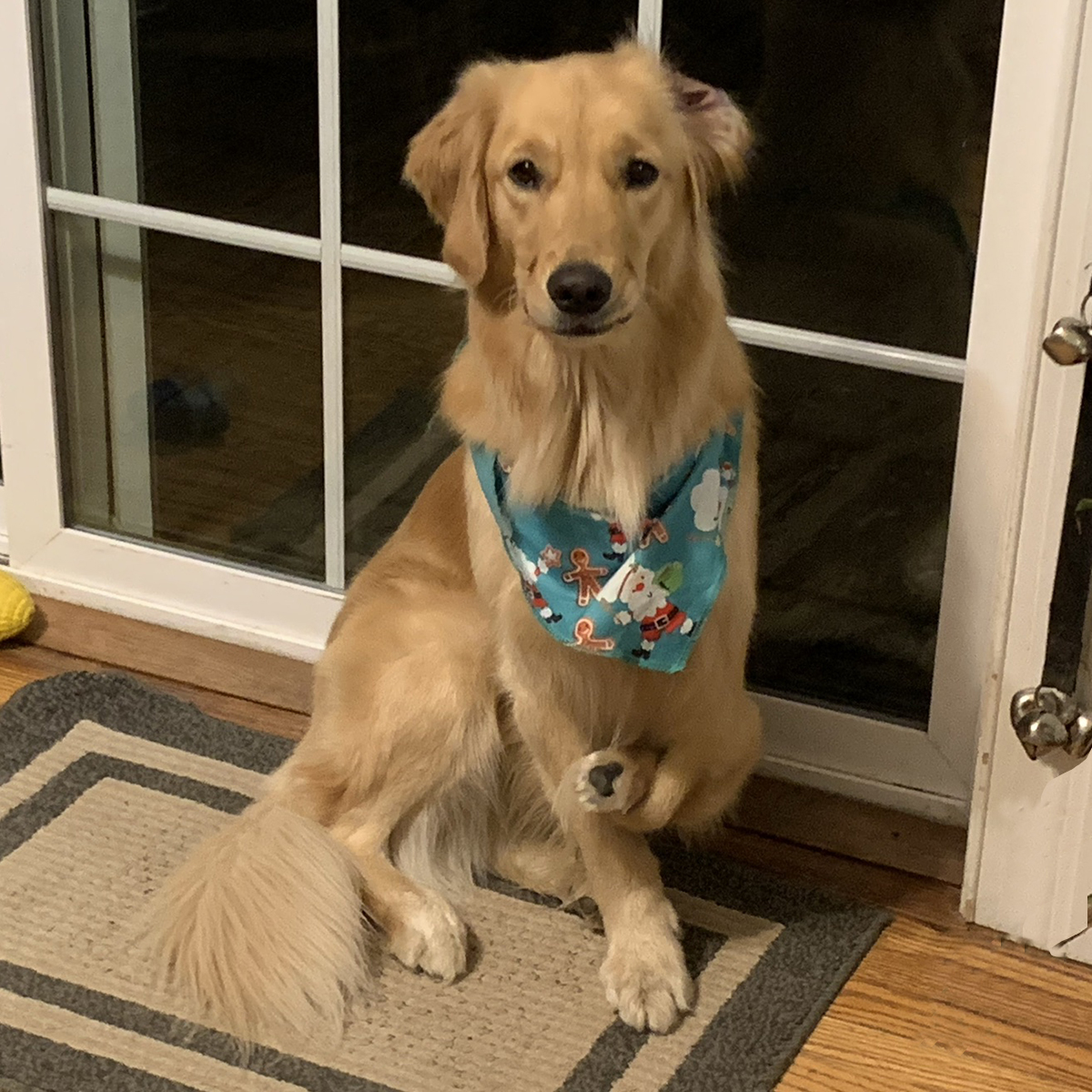
When people notice Millie’s front leg, they often ask what happened.
Millie was born with a congenital condition called radial hemimelia — a birth defect where the radius bone in the front leg is partially or completely missing. It’s sometimes referred to as radial agenesis or congenital radial deformity.
It can cause:
-
A shortened or curved front leg
-
The paw to rotate inward
-
Limited weight bearing
-
A “tripawd” appearance, even though the limb is still present
It is present at birth and not caused by injury.
The Advice We Received
The very first time we took Millie to the vet, we were told:
“We would wait until she turns one year old, then amputate the leg so she can wear a prosthetic.”
At the time, we believed this was standard thinking. Many veterinarians are trained to view amputation as the most functional long-term solution for limb deformities.
But as Millie grew, we began to notice something important.
She used that leg.
She used it to hold toys.
She used it to brace herself when playing.
She used it to interact with us.
And most importantly — it was not painful for her.
What We Later Learned
After speaking with a pet prosthetic specialist, we learned something that surprised us:
In many cases of radial hemimelia, amputation is not automatically the best solution.
In fact, it is often much easier to build a prosthetic around an existing limb than to attach one after amputation.
An existing limb provides:
-
Natural attachment points
-
Better stabilization
-
Improved proprioception (body awareness)
-
Greater long-term adaptability
Once a limb is removed, those advantages are gone permanently.
This isn’t widely discussed in general veterinary practice — not because vets don’t care, but because prosthetics and orthotics are a highly specialized niche. Many general practitioners simply aren’t exposed to that side of care.
An Important Note About Timing
If we had introduced and trained Millie with a prosthetic from the time she was a puppy, she very well might be wearing one comfortably today.
Early conditioning can make a significant difference in long-term acceptance.
But by the time we explored that path, Millie had already fully adapted to her body. She was thriving. Confident. Fast. Functional. And she made it very clear she preferred life without it.
Every case is different.
Some dogs truly need amputation.
Some thrive with early prosthetic intervention.
And some — like Millie — simply don’t need either.
More Than a Diagnosis
Radial hemimelia may be the medical term.
But it is not Millie’s identity.
She runs.
She swims.
She works as a therapy dog.
She loves every human she meets.
She isn’t missing anything.
She’s just built differently — and perfectly for her mission.